 Cart
Cart







| Coad | 672055 | Type | CCD Cameras | |
| Dimension | 118 x 163mm / 118 x 170mm(With shutter) | CCD Format | 1024 x 252px |
| Pixel Size | 26.0 x 26.0μm | Image Area | 26.0 x 6.6mm | |
| Pixel Fill Factor | 100 | Dark current@-75°C (e-/p/sec) | 0.3(typical) |
| Deepest Cooling Temperature | -75°C | Thermostating Precision | ±0.05°C across entire temperature range | |
| Vertical Shift Speed | 15 μsec/row | ADC Speed/Bits | 100kHz/16-bit and 2MHz/16-bit |
| Non-linearity | <1%@100kHz | Data Interface | USB2.0 | |
| Certification | CE | Weight | 2.27kg (5lbs) |
| Optical Mount | Princeton Instruments Acton spectrometer adapter with optional shutter | Cooling Method | Thermoelectric air or liquid cooling (CoolCUBE II required) | |
| Spectrometric Well Capacity(High Sensitivity) | 500 ke- (typical), 400 ke-(min) | Spectrometric Well Capacity(High Capacity) | 1000 ke- (typical), 750 ke-(min) |
| System Read Noise@100 kHz | 6e- rms | System Read Noise @2 MHz | 22e- rms | |
| Software Selectable Gains | 3 e-/ct(High),6 e-/ct(Mid),12 e-/ct(Low) | Operating Systems Supported | Windows 8/7/XP (32-bit), Windows 8/7 (64-bit) and Linux |
| Dynamic range | 16 bits | Operating Environment | +5 to +30°C, non-condensing atmosphere | |
| Features | Back-illuminated, deep depletion CCD. High QE in the NIR with minimal etaloning. |
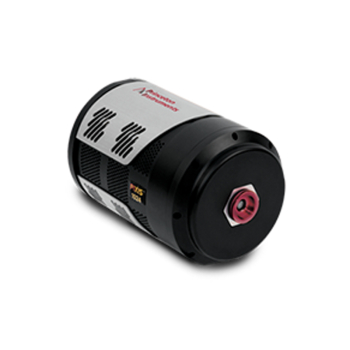
The PlXlS series from Princeton Instruments (Pl) are fully integrated, low noise cameras designed for quantitaive scientifc imagingoptical spectroscopy applications. Designed utilizing Pl's exclusive XP cooling technology, PlXlS offer the rmoelectric cooling down to -75'C, while the all-metal, hermetically sealed design, with the industry's only lifetime vacuum guarantee, ensures maintenance free operation. The PlXlS: 256 uses high performance, spectroscopic-format industry standard CCDs, with deep cooling to provide the lowest dark charge. The 1024 array with 6.7mm chip height and 26mm spectral coverage is ideal for multistripe spectroscopy and maximum light collecting area. This detector provides excellent response from the vacuum UV to the NlR, and with its proven system reliability, is ideal for OEM and laboratory applications.


Product evaluation
%High praise
There are comments